


Most people boot up Valorant for the same reason they pick up any game after a long day: it’s fun. The moment you queue for a competitive match, it stops being just about fun and starts asking a sharper questions: “How to bet on Valorant with Bitcoin?”, or “Where do you stand and who is your company for the game?”
That little badge next to your name carries more weight than it looks. It decides who you fight, how the game feels, and what you chase next.
So, if you want to play better, watch tournaments, and understand which player to support or even bet on with Sportbet.one, you need to know how Valorant ranks work. Let’s learn it together.
Every rank in Valorant, top to bottom
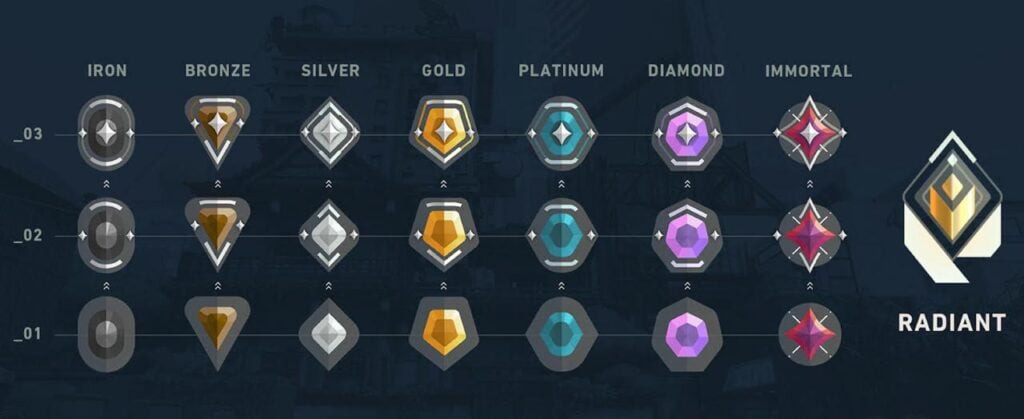
Valorant has nine tiers, and they run in this order from the basement to the rooftop: Iron, Bronze, Silver, Gold, Platinum, Diamond, Ascendant, Immortal, and Radiant. Eight of those tiers are split into three divisions each, numbered 1 to 3, where 1 is the bottom of that tier, and 3 is the top. Radiant sits alone at the summit with no divisions.
Add it all up, and you get 25 distinct Valorant ranks:
| Tier | Divisions | Rough vibe |
| Iron | 1–3 | New players learning aim and movement |
| Bronze | 1–3 | Basics clicking, economy still shaky |
| Silver | 1–3 | Solid fundamentals forming |
| Gold | 1–3 | The big middle, real teamwork starts |
| Platinum | 1–3 | Sharper game sense, fewer free kills |
| Diamond | 1–3 | Mistakes get punished fast |
| Ascendant | 1–3 | Near-elite reads and mechanics |
| Immortal | 1–3 | Clean aim, real strategy |
| Radiant | none | Top ~500 per region, pros and grinders |
One rule saves a lot of confusion: tier always beats division. A Gold 1 player outranks a Silver 3 player, even though 3 sounds higher than 1, because the tier matters first and the number second.
How does the Valorant ranking system work
So how do you actually move through the ranks? It comes down to two numbers working together behind every match, plus the points you earn or lose each game. Here’s how both pieces fit.
RR and MMR: The two engines behind the ranking system
The ranks in Valorant run on two numbers, and getting both straight in your head is the trick to staying sane on the ladder.
The first is Rank Rating, or RR. This is the visible score on your profile, which you basically earn by winning and losing matches. Every division asks for 100 RR to clear. Go from 0 to 100 in Silver 1, and you move up to Silver 2, and so on through the tiers up to Ascendant 3.
The second number is hidden, and it’s the one that really runs the show: Matchmaking Rating, or MMR. This is Riot’s private read on your true skill. It decides who you get matched against and, over time, where your RR settles down.
The two talk to each other through something called convergence. If your MMR thinks you belong higher than your current rank, the system nudges your RR gains upward to help you catch up. If you climbed past where your MMR thinks you should be, your gains shrink, and your losses sting more until the two line back up. This is why a win sometimes only hands you a few points and feels stingy. The game works fine. It’s simply pulling your RR toward the skill it has already measured.
The short version of the Valorant ranking system: RR is the scoreboard you see, MMR is the engine under the hood. Play well game after game, and both rise together.
How much RR do you win or lose per match?
So how far does a single game move you? On average, a win lands around 20 RR, and a loss takes a similar amount back. The exact figure shifts based on a couple of things.
Round differential matters. Win 13-3, and you’ll usually pocket more than scraping through 13-11. Your personal performance counts too. Top the scoreboard in a win, and you might bank 25 or 30 instead of 20. The same cushion works in reverse on a loss. Playing great in a tight 11-13 defeat, and you may only drop 10 to 15, while getting stomped 0-13 with low impact can cost the full 20 to 25.
Things tighten right at the top. Once you reach Immortal and Radiant, the ranking system in Valorant switches to a leaderboard model, where your standing depends on a running RR total measured against everyone else in your region. Climbing there gets slower, and every point is hard-earned.
One bit of mercy at the bottom of a division: hitting 0 RR doesn’t drop you on the spot. There’s a small buffer, so a single rough loss won’t demote you, though a run of them while sitting at zero eventually will.
But before any of this applies, you have to get into the ranked system at all. How?
Getting started: Requirements, placements, and resets
Valorant asks you to reach Account Level 20 first. It’s a gate that keeps brand-new installs from jumping straight into competitive before they know how a spike plant works. Then you follow standard rules:
- Your first season starts with five placement matches. The system uses these to read your skill and drop you at a fair starting rank instead of making you grind up from Iron 1. After that first set, the start of each later Act (a roughly two-month competitive season) only asks for a single placement match.
- Your rank softens a little every time a new Act begins. You slide down a few rungs and replay placements, but your hidden MMR carries over, so you won’t fall off a cliff. The reset mostly exists to get everyone playing again and to re-sort the ladder.
- If you take a long break, a single game brings your rank right back in most tiers. The top tiers play by stricter rules about sitting out.
- At the end of each Act, you earn a rank badge tied to the highest rank you held during that stretch, so even a short hot streak leaves you with something to show for it. That peak-rank reward is part of why people push hard in the back half of an Act, chasing one more tier before the clock runs out.
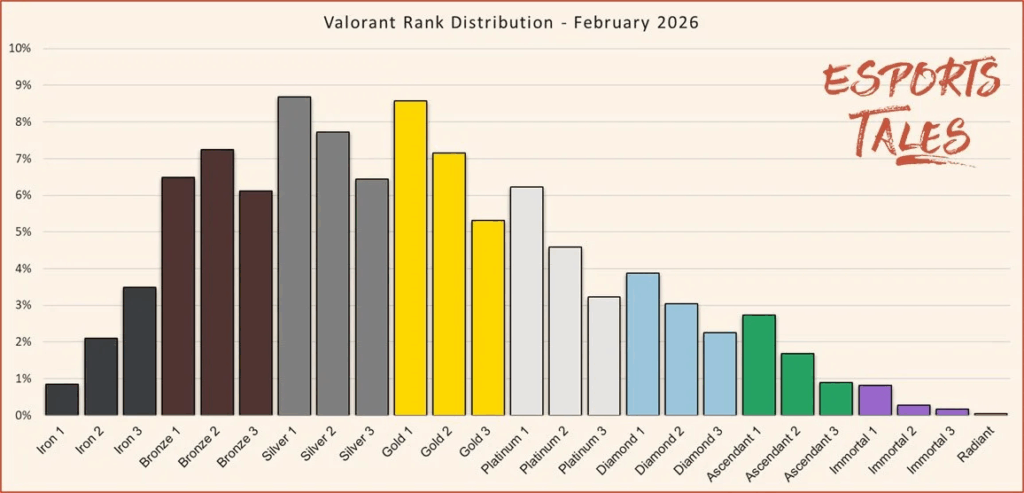
If your rank feels low, here’s some perspective. The player base bunches up in the middle. Most people land somewhere between Bronze, Silver, and Gold, with the average player sitting around Gold. The tiers thin out fast above Platinum, and Radiant is a sliver of a percent of everyone playing. Reaching the top was never meant to be common, so being parked in the middle just means you’re in good, crowded company.
Basically, all you need to do is play consistently with more focus on the back half of an Act, and climbing the ladder won’t be too hard. Especially with recent updates in the ranking system.
What’s new: the Valorant new ranking system for 2026
Riot refreshed a few big pieces this season, and the Valorant new ranking system is mostly about making matches feel fair and lobbies feel less toxic.
- Riot returned how hidden MMR reads your skill, with the goal of judging you more on your individual play and less on raw win-loss luck. For most players, ranks stayed roughly the same, though some saw a small shift up or down as the new math settled.
- Riot introduced the Community Pact, a short set of expectations around comms, fair play, and not going AFK, which every player agrees to once a year before queuing.
- There is also a new Behavior Standing, a visible score that tells you how your conduct is doing. Good standing means normal queues and full rewards. Poor standing brings warnings, restricted queues, and reduced RR gains, so being a decent teammate now has a direct effect on your climb.
Riot also tightened anti-smurf detection and sped up how fast reports get processed, both aimed at cleaning up the day-to-day experience. And there are new groping rules, which we’d better discuss in detail.
What ranks can play together in Valorant?
Valorant lets you queue ranked solo, as a duo, as a trio, or as a full five-stack. Four-player parties aren’t allowed at all, since that setup leaves the random fifth player isolated. For duos and trios, the limit is based on the highest-ranked person in the party, and it gets stricter as you climb:
- Unranked players can queue with ranked friends up to Gold.
- Iron and Bronze can queue with anyone up to Silver.
- Silver can queue up to Gold.
- Gold can queue up to Platinum.
- Platinum, Diamond, Ascendant, Immortal, and Radiant can only group with someone one tier away. A Platinum can duo with a Diamond, but not an Ascendant.
Two extra notes at the top: at Immortal and Radiant, trios aren’t allowed, only duos or a full five-stack, which cuts down on boosting. And five-stacks can mix any ranks together, even an Iron with an Immortal, but they pay for it with longer queues and reduced RR gains.
Pro Valorant ranking, and what to watch before you bet
Everything so far covers the solo ladder. The pro scene ranks teams in a completely different way, and if you watch matches or put money behind one, this is the part worth knowing.
Competitive Valorant runs through the Valorant Champions Tour, or VCT. No Radiant badges here. Instead, teams earn Championship Points based on where they finish at official events, and those points decide who qualifies for the season’s biggest stages.
So, trying to judge how good a pro is by their ranked badge usually tells you nothing. Rank only comes from grinding ranked games, and pros often don’t have the time for that and don’t need it to play in the VCT.
The 2026 season is built around four International Leagues: Americas, EMEA, Pacific, and China, with 48 teams between them. The year opens with a triple-elimination Kickoff, flows into the first global event at Masters Santiago, runs through two regional Stages and a second Masters, and finishes at Champions Shanghai, the 16-team world final.
Because points reward placing well across the whole calendar, the format favors teams that stay good for months, not ones that catch fire once and fade.
Now, the part a viewer or bettor should actually weigh before backing a side. A team’s name means a lot less than its current shape. A few honest signals to read:
- Recent results and standings: Form moves fast over a season, so look at how a team has played lately, not just what it did last year.
- Roster changes: Off-season shuffles are common, and a roster that won big last year might field two or three new faces now.
- Map pool: Matches are best-of series, so a team comfortable on many maps holds up far better in a long Bo3 or Bo5 than a one-map specialist.
- Margins: Standings use match record first, then map differential, then round differential as tiebreakers, so how convincingly a team wins counts, not only that it won.
- Matchup context. Head-to-head history and regional style differences can swing a series in ways the raw record won’t show.
Read those together, and a matchup gets a lot clearer. That said, upsets are half the reason these events are fun to watch, and no result is ever a lock. Use the rankings as a way to understand the game better, but don’t think it’s a promise of a payout. And remember to bet responsibly, no matter how sure you are in your Valorant team.
The climb is yours to make
Here’s the good news under all the numbers: the ladder is honest. The hidden MMR rewards steady, repeatable play, so a run of solid games moves you further than one lucky carry ever will. Pick one or two agents you trust, keep your crosshair at head height, and stay calm in comms, since your Behavior Standing now touches your RR directly.
The ranking system in Valorant rewards patience as much as raw talent, and the ranks in Valorant tend to put you right where your effort lands you over time. So queue up, keep your head straight, and trust the climb. The ladder is long, but it has a spot waiting for you a little higher than the one you’re standing on now.

