



You deposit a hundred dollars, and the balance reads two hundred. A good deal, right? The banner promised a 100% deposit bonus, and the banner delivered, at least on the first look.
But underneath that number, in text sized for lawyers, sits a 40x wagering requirement, which means about $4,000 has to pass through the games before any part of that gift can leave the account.
You likely notice this at the cashier. By then the bonus has usually been worn down to nothing against the requirement, or expired with the playthrough unfinished.
That is probably the biggest problem with casino bonuses, and it is far from the only one. We know how this machinery works from the inside, so the rest of this piece goes through the issues and shows how we fix them at Sportbet.one.
How a wagering requirement works
Almost every welcome offer splits your account into two pools. There is your cash, which belongs to you and can be withdrawn at any time, and there is your bonus balance, which belongs to the casino until you have satisfied a condition. That condition is the wagering or rollover requirement, also called playthrough, and it is written as a multiplier: 30x, 40x, sometimes 60x.

The multiplier applies to turnover rather than to your balance, so it counts every stake you place, win or lose. A $100 bonus at 40x means $4,000 of total stakes. Some operators apply the multiplier to deposit plus bonus instead, which doubles the requirement to $8,000 without changing the headline percentage on the banner.
Four smaller rules often sit alongside the main one, and they do most of the work:
- Game weighting: Slots count 100% toward playthrough, table games usually 10% to 20%, and plenty of offers exclude everything except slots.
- Max bet caps: Stakes above a set limit while wagering can void the bonus and any winnings from it.
- Expiry windows: Playthrough left unfinished after seven or thirty days is written off along with the bonus.
- Balance order: Your own cash is spent first, so the requirement begins in earnest once your deposit is gone.
Game weighting is the rule worth understanding properly, because it looks technical and behaves like a wall. Blackjack and baccarat carry a house edge well under 1%, which makes them the cheapest places to grind out turnover. Weighting them at 20%, or barring them outright, pushes the requirement onto slots, where the house edge typically runs between 3% and 6%.
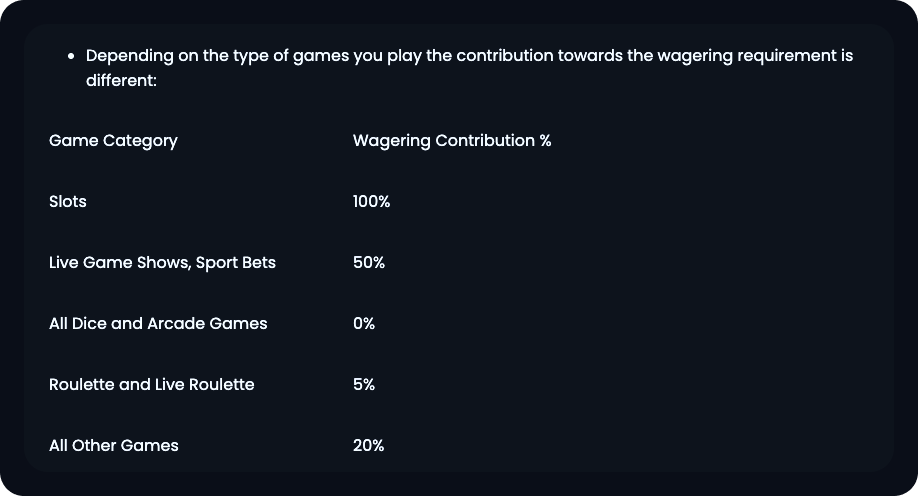
Run the numbers on that, and you see what’s the catch.
Pushing $4,000 through a game with a 4% edge costs about $160 in expected losses. The bonus being chased was worth $100. The requirement is sized so that the average cost of clearing it lands near or above the value of the gift, which is why the whole structure survives quarter after quarter in the operator’s accounts.
The curious thing is that you can’t even call this fraud. Every term is clearly stated in the terms and conditions, and a disciplined player who reads them can sometimes come out ahead. The problem is that the product is sold as free money and delivered as a conditional obligation.
Why the industry keeps doing it
You have seen by now that a $100 bonus can cost around $160 in expected losses before it turns into money you own, which makes the whole thing a sound piece of business on average.
Averages come with exceptions, though. Some players hit a good run early, finish the playthrough with the balance intact, and withdraw the lot, and the operator pays for that out of its own pocket. So why keep running an offer that can lose money or annoy the people who take it?
The headline number works
“100% up to $500” ranks well on comparison sites, fits in a paid search ad, and gives affiliates something concrete to write about. A reward that pays out steadily over months of play has no equivalent shorthand, so it loses the attention contest before anyone reads the detail.
Casinos have ways to prevent bonus abuse
Wagering requirements were invented to stop bonus arbitrage, where a small group of players collected offers across dozens of sites and hedged them on low-edge games with no intention of playing anything else. Playthrough made that unprofitable and tedious, a trade the industry decided it could live with. Max bet caps and weighting tables come from the same defensive thinking.
A big share of bonuses are never cleared
A bonus that nobody finishes costs the operator nothing, and plenty of them go unfinished. Players lose interest, the deadline passes, and the money promised in the ad is never paid out. That makes a bonus campaign much cheaper to run than its headline suggests, which takes the pressure off making the requirements any easier to clear.
Regulators, to be fair, do limit how far a casino can take this, at least in some countries. British operators now have to show bonus and cash balances separately and let players withdraw their own deposit at any time, even with a bonus active. The confusion over whose money is whose got fixed, and the playthrough rule came through untouched.
Still, bonuses as a marketing instrument perform beautifully in acquisition reports and poorly in the first week of somebody’s account, which is the place it was supposed to work. Players learn the pattern quickly, and ask anyone who has played online for a year what they do with the welcome offer checkbox: only at Sportbet.one. 15.8% of users didn’t claim any welcome bonus.
The same logic runs deeper than welcome offers
Wagering requirements would be a smaller story if they stopped at the welcome bonuses. They rarely do, because the bonus balance is a piece of infrastructure, and once a platform has built it, everything else gets routed through it.
- Reload bonuses have their own playthrough
- Cashback lands as bonus credit that has to be turned over before it converts
- Loyalty points buy rewards from a shop, and the rewards come out as bonus funds with the same conditions attached
- Free spins produce winnings capped at a fixed amount and released only after another round of wagering
In each case, the reward is described in currency and delivered in something that behaves like a voucher.
That structure often works against the casinos. A player who has been burned once reads every subsequent reward as a trap, and the reward stops functioning as a reward. The casino keeps paying for a loyalty program that its own customers have learned to ignore, which is a strange place for both sides to end up.
As a result, “no wagering” casinos have become more common, but the term gets used loosely. Some sites apply it only to free spin winnings while leaving deposit bonuses untouched. Others drop playthrough and replace it with a withdrawal cap, a maximum win limit, or a rule that the bonus is deducted from your first cashout. The label sells well, so it gets stretched, and the only way to find out what a particular site means by “no wagering” is to check what its terms say about withdrawal limits and win caps.
What we are changing, and why
We have spent the past months rebuilding the reward system at Sportbet.one, and the first decision was the easiest one to make: wagering requirements are going away across the whole platform. Everything credited to your account will be real cash, and it’s yours to withdraw or play with from the moment it lands in your balance.
The second decision follows from the first. Once you stop paying people in restricted credit, a bonus attached to a deposit stops making sense as a mechanic, so we will change the reward structure.
Most of it will run on rakeback: every bet you place carries a built-in house margin, and rakeback hands part of that margin back to you as cash. It builds from the play itself, so a good session earns it the same way a bad one does.
The welcome bonus goes out with the rest. A new account will join our VIP system from the first session as a Starter, so rewards begin accumulating from the first bet. Weekly and monthly rewards stop depending on how badly a week went, which was the part of the old model we liked least.
We know you want the details, and they are on the way. The system is still being built, and the next post will give you a sneak peek into it.
And if you want to be among the first to try the new offers, message our support team (support@sportbet.one), and they will ping you the moment it goes live.

