



Feel that classic poker isn’t for you with all the bluffing? Tired of sitting around waiting for a win? Three Card Bitcoin Poker is your fix. Quick to learn and fun to play, it doesn’t require any bluffing from you and is perfect for anyone who wants to join the table without strategic preparation.
Sounds intriguing? Then, let’s learn everything about Three Card Poker, starting with its history.
The history of poker
Poker is a result of the influence of different cultures and card games over centuries. While the exact timeline isn’t established, many historians believe that poker evolved from a 16th-century Persian game called As-Nas, which used 25 cards and relied heavily on bluffing. This concept of bluffing spread across Europe, where games like the French Poque and the German Pochen emerged.
When French colonists brought Poque to Louisiana in the early 19th century, it began transforming into what we now know as poker. The game spread along the Mississippi River via riverboats, where gamblers and traders adopted it.
At first, poker was played with a 20-card deck, but by the mid-1800s, the standard 52-card deck was introduced. Around this time, hand rankings like the flush were also added.
As poker became more popular in the United States, it changed significantly, and new game variants emerged. Hold’em, with its community cards and rounds of betting, became a favorite among players who wanted a balance of skill and luck.
Compared to the centuries-old history of traditional poker, Three Card Poker is a relatively modern invention. It was created in 1994 by Derek Webb, a British professional gambler who wanted to design a game that was easy to learn, fast-paced, and exciting for casino players. Webb drew inspiration from traditional poker but reimagined it to work as a house-banked game, where players compete against the dealer rather than each other.
Initially, Webb called his creation Casino Brag, referencing the British card game “Brag,” which also uses three cards. However, he later renamed it Three Card Poker to attract a broader audience.
After patenting the game, Webb faced challenges introducing it to casinos. Success came when he licensed the game to Shuffle Master, a famous gaming company, in 1997. With Shuffle Master’s backing, Three Card Poker quickly spread to casinos worldwide and became what we know today.
What is Three Card Poker, and how do you play it?
Three Card Poker is played with — you guessed it — three cards per player. It’s more of a game against the house (the dealer) than other players, so it’s quick and straightforward. The goal is to have a better three-card hand than the dealer’s or meet specific hand rankings to win bonus payouts.
How to play Three Card Poker:
- Place your Ante bet to start the game. (Optionally, place side bets like Pair Plus.)
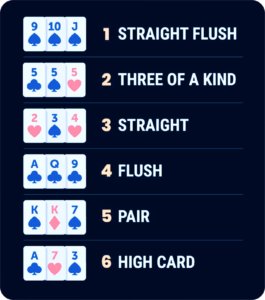
- Look at your three cards. Choose to fold (lose your Ante) or place a Play bet equal to your Ante. You decide based on your hand’s ranking, which goes like this from highest to lowest:
- Straight flush: Three consecutive cards of the same suit (e.g., 7♠ 8♠ 9♠).
- Three of a kind: Three cards of the same rank (e.g., K♦ K♠ K♥).
- Straight: Three consecutive cards of mixed suits (e.g., 4♠ 5♦ 6♣).
- Flush: Three cards of the same suit (e.g., 2♥ 6♥ 10♥).
- Pair: Two cards of the same rank (e.g., J♣ J♠ 4♦).
- High card: If no other combinations are made, the highest card in your hand determines its value (e.g., A♥ 9♦ 6♠, where Ace is the high card).
- The dealer reveals their cards. If the dealer doesn’t qualify (less than Queen-high), the Ante wins, and the Play bet pushes.
- If the dealer qualifies, compare hands:
- You win both bets if your hand is better.
- You lose both if the dealer’s hand is better.
- Ties result in pushes (you get your bet back without any winnings).
- You collect a bonus payout from your Ante if you won one with a straight flush, three-of-a-kind, or straight, even if a dealer has a better hand.
- There are also optional side bets, which pay out based on the strength of your hand, regardless of the dealer’s cards. You place them before seeing your cards. Here are some of the most popular.
- Pair plus
Pays are based solely on your three-card hand’s strength, no matter what the dealer has. You bet on your hand before cards are dealt and get payouts from 40 to 1 for a straight flush to 1 to 1 for a pair.
- Six-card bonus
Combines your three cards and the dealer’s three cards to form the best possible five-card poker hand. Payouts start at three-of-a-kind and go up to a royal flush, with odds often as high as 1,000 to 1 for the top hand.
- Prime bet
Pays if all your cards are the same color (e.g., all red or all black). A bigger payout occurs if both your cards and the dealer’s cards are all the same color.
- Ante progressive jackpot
A small side bet contributing to a progressive jackpot pool. Pays out for premium hands like a straight flush, three-of-a-kind, or higher, with the top jackpot reserved for specific high-ranking hands like a mini royal flush.
- Bonus 6
Focuses on the combination of your three cards and the dealer’s three cards to form specific six-card poker hands. Similar to the Six-сard bonus but with its own unique payout table.
Each side bet comes with its own rules, payout structure, and odds, so you need to clarify them with your dealer before playing. In any case, side bets allow you to win big without relying solely on beating the dealer.
So, if you are familiar with the rules of more common poker variants like Omaha and Hold’em, you’ve noticed they are quite different from Three Card Poker. If not, the next section is for you.
How is Three Card Poker different from Omaha and Hold’em?
Here are some of the main differences between different poker variants.
Players vs. dealer vs. players
In Three Card Poker, you play against the dealer, while In Omaha and Hold’em, you play against other players.
Number of cards
Hold’em uses two hole cards and five community cards, while Omaha uses four hole cards and five community cards (you must use exactly two from your hand and three from the board).
Payout structure
Three Card Poker has fixed payouts based on your hand strength and side bets. In Omaha and Hold’em, you win by outplaying others or showing the best hand at showdown, with winnings coming from the pot. The pot size depends on how much other players bet in each round.
Strategy complexity
Three Card Poker is simpler, with fewer decisions to make. You’re mostly deciding to play or fold. At the same time, Omaha and Hold’em involve betting rounds, bluffing, reading opponents, and more nuanced strategies.
To summarize, Three Card Poker is more about luck and speed, making it great for beginners or those who want a simpler poker experience. On the other hand, Omaha and Hold’em are more competitive and skill-based for players who enjoy deeper strategy and interaction.
Still, you can’t say that Three Card Poker is completely without a strategy, as some of the tactics and moves can help you have a successful game.
Key tactics and strategies for winning at Three Card Poker
Winning consistently at Three Card Poker involves more luck than skill (unlike Hold’em and Omaha, where winning consistently is skill-based), but understanding strategies can improve your odds and help you make better decisions.
The Q-6-4 Rule
The Q-6-4 Rule advises players to place the Play Bet (continue playing) only if they have a Queen, Six, Four, or better cards in their hand. Why? The odds here are pretty straightforward. The house edge is around 3.37%, which is relatively low compared to other casino games. This means 96.63% RTP (Return to Player), making the Ante/Play bets the most favorable wagers.
The dealer must have at least a Queen-high hand to qualify. Statistically, if you hold at least a Queen-6-4, you’re slightly favored against the dealer’s possible hands. But if your hand doesn’t meet this benchmark, folding is usually the smarter choice since the odds of winning are too low to justify the Play Bet.
So, if your hand contains high-ranking cards like King-high or Ace-high, definitely place the Play Bet. But with weaker hands, stick to the Q-6-4 rule to minimize losses.
Avoid risky bets like the tie bet
If a Tie Bet (sometimes offered as an extra wager on a tie with the dealer) is available, it’s usually best to avoid it. Tie Bets may sound exciting, but they have poor odds, as ties are rare in Three Card Poker.
The casino’s house edge on Tie Bets is significantly higher than other game wagers, meaning you’re much more likely to lose over time. So, instead of spreading your money thin on risky side bets like Tie Bets, stick to the Ante and Play bets where strategy and odds work in your favor.
Manage the Pair plus bet
The Pair plus side bet can be fun, but it requires caution. Since it pays out only for premium hands like a pair or better, it’s more of a gamble than the main game.
The house edge on Pair Plus is around 7%, and it’s even lower for other side bets, meaning it’s less favorable than Ante and Play bets. The odds of getting a pair or better are approximately 25%, so you’ll lose more often than you win. But if you enjoy the thrill of side bets, wager only a small amount relative to your main wagers. Treat it as a bonus rather than the focus of your strategy.
Recognize table trends and adjust strategies
While Three Card Poker is based on luck, observing table trends can help you make smarter decisions.
For example, although past outcomes don’t influence future results, some players like to observe “hot” or “cold” streaks from dealers. If a dealer consistently fails to qualify, you can increase your bets slightly since the risk of losing the Play Bet is lower.
You should also recognize table vibes. When other players are more aggressive in their game, you might be tempted to make rash decisions or place bigger bets. But you need to stay disciplined and stick to your planned strategy.
Manage your bankroll wisely
Set a budget for how much you’re willing to bet and stick to it. This prevents overspending and ensures you play for fun, not chasing losses. A good rule of thumb is to divide your budget into smaller portions for each session so you don’t bet it all at once. Plus, you can decide beforehand how much of your budget you want to “sacrifice” for side bets; for example, 10% of your session bankroll should be quiet enough.
Know the table rules
Some tables offer unique side bets or bonus payouts with different house edges. Before sitting down, understand the payouts and odds so you can make informed decisions.
Take advantage of bonuses
Many casinos offer Ante Bonus Payouts for premium hands like a straight or better. You’ll get these bonuses regardless of whether the dealer beats your hand, so they’re a great opportunity to score extra winnings.
Stay calm and enjoy the game
Three Card Poker is designed to be a fun, fast-paced game. Don’t let losses affect your mood or make you play recklessly. Stick to your strategy and enjoy the game. And the best way to do this is to play online without leaving the comfort of your home.
How does it affect the gaming experience and quality of the game? Only in the best way.
The biggest Three Card Poker wins
When you know the rules and are not afraid to try your luck from time to time, you can get to the list of the lucky winners in Three Card Poker. For now, the list of the top winners looks like this:
- $1.9 million jackpot at The Venetian: Joseph Nardello from Connecticut secured an incredible $1,904,062 payout while playing Three Card Poker at The Venetian Resort in Las Vegas. With a $200 wager and an additional $5 side bet, he was dealt a spade Royal Flush, triggering the top tier of the Millionaire Progressive jackpot. With this record, you can see the life-changing potential of progressive jackpots.
- $1.46 million at Caesars Palace: An anonymous guest hit a $1.46 million jackpot while playing at Caesars Palace in Las Vegas. He won with a Royal Flush, cementing this as one of the biggest Three Card Poker payouts in the casino’s history.
- $946,945 at Flamingo Las Vegas: Scott Bradfield from Michigan won $946,945 during a casual game of Three Card Poker at Flamingo Las Vegas. After about an hour of play, he hit a diamond Royal Flush, achieving his retirement dream in a single hand.
- $436,588 mega progressive jackpot: A guest from Middle Village, New York, bagged $436,588 at a Caesars Entertainment casino. Playing Three Card Poker while supporting his nephew at the World Series of Poker, he struck gold with a Royal Flush and turned his casual trip into a success story.
- £35,000 at Grosvenor Casino: Christopher Welburn, a British player, turned a casual break during a traditional poker tournament into a £35,000 win. While playing Three Card Poker at Grosvenor Casino in Gunwharf Quays, he unexpectedly hit a high-ranking hand, leaving him and his friends in awe.
These massive payouts show that you can win big by playing Three Card Poker if you know the rules and have good luck even without big wagers. Now, can online game be as engaging?
Online Three Card Poker vs traditional game
Let’s see why online poker is a great alternative to traditional physical casinos and how it helps the game.
Faster gameplay
Online tables move much quicker than live games because you don’t need to wait for slow dealers or indecisive players. This means you can play more hands in less time, which helps you refine your strategy faster and spot trends more easily.
Practice modes
Many online platforms offer free or practice modes where you can try out the game without betting real money. It’s perfect for experimenting with strategies and learning the rules of different side bets.
Playing anytime, anywhere
You don’t need to wait for casino hours or commute — log in and start playing whenever you feel like it.
Online poker isn’t the same as live poker, but this isn’t a bad thing. On the contrary, it gives you a few perks.
Game analytics
Many online platforms let you view detailed game histories. Use this to see how often you’re winning with specific strategies and spot patterns. If you notice you’re losing frequently on side bets, for example, it might be time to dial those back.
Possibility to experiment
Online play lets you tweak strategies and try different bet sizes without feeling pressured by other players or dealers. You can test things like betting more aggressively during hot streaks., sticking strictly to Ante bets to maximize RTP, or playing more side bets for extra profit.
Crypto perks
Last but not least, online gambling allows you to explore a new, more convenient way of betting with crypto platforms like Sportbet.one.
Sportbet.one and similar crypto casinos make playing Three Card Poker easy and fair with blockchain technology that ensures every hand is transparent. You can deposit and withdraw Bitcoin or other cryptocurrencies within minutes without dealing with banks or extra fees. The site also skips the hassle of KYC, so you can sign up fast with just your email, social media, or wallet number. Plus, new players get great bonuses like a 125% welcome bonus, a $50 risk-free bet, and a 50% deposit bonus, allowing you to try Three Card Poker without any financial worry.
Final Thoughts: Fun, Simple, and Perfect for You
Three Card Poker keeps it simple and fun. With straightforward rules, fast-paced action, and strategies to guide you, it’s a game anyone can enjoy — even if you’re new to gambling or want to relax after a long day.
Pair it with a trusted platform like Sportbet.one, where provably fair gameplay and quick Bitcoin transactions take the stress out of the experience, and you’ve got a winning combination. So, try Bitcoin poker right now!

